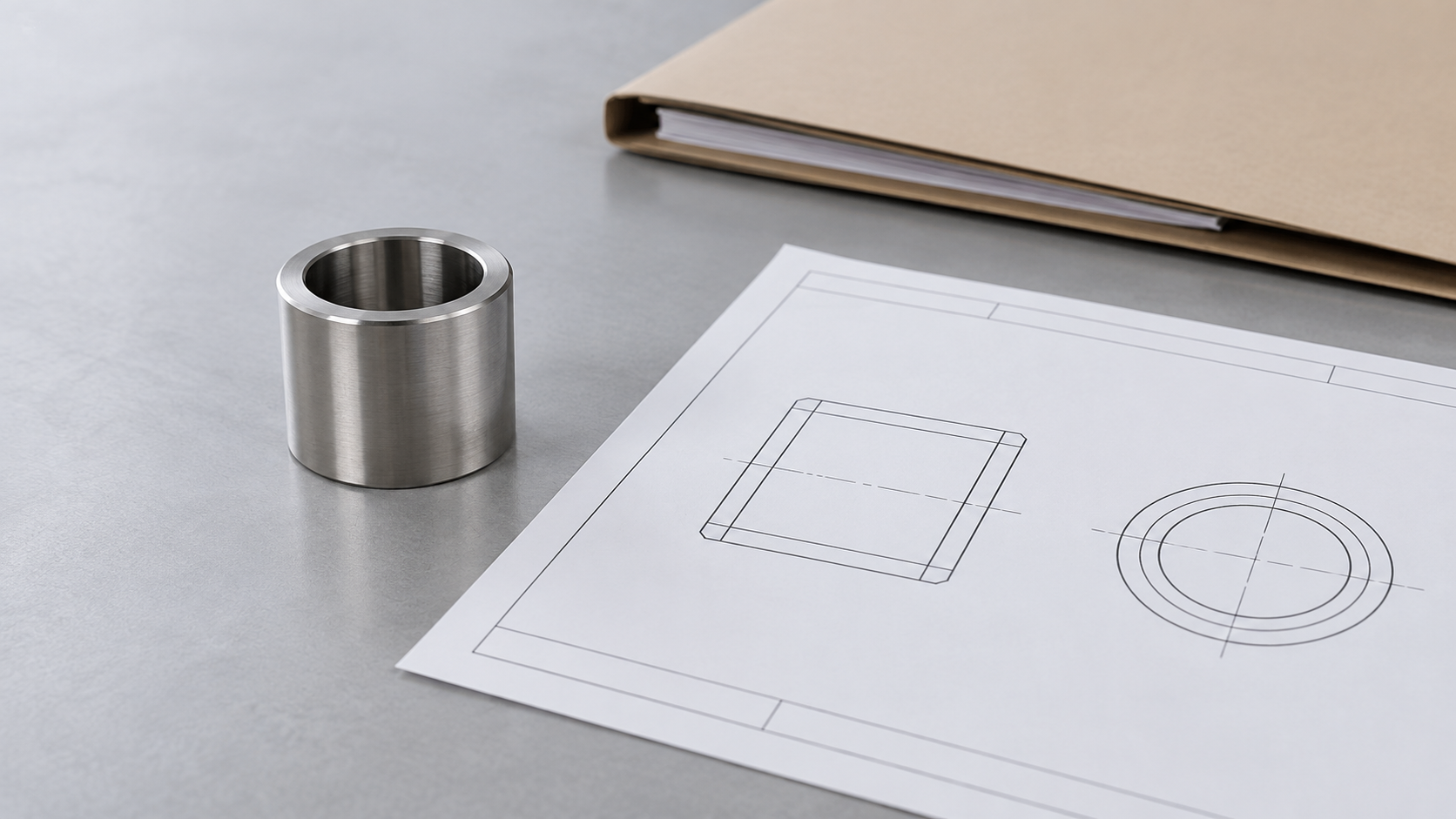
Your drawing shows one opening, but the brass sample on the desk looks different. Sending both to a supplier without an explanation can produce a quotation for a part nobody intended. Before evaluating a stainless replacement, make the disagreement visible and decide who can resolve it.
You do not need to solve every technical question yourself. Purchasing needs a reliable way to distinguish the current requirement, historical information, and unresolved differences. A clear discrepancy record lets the supplier help with the right question without silently choosing which reference to trust.
Identify every reference separately
Give the sample, drawing, model, and photographs distinct identifiers. Record where each came from and, where known, its revision or date. A recent email attachment may contain an old drawing; the date it was forwarded does not establish that it is the current instruction.
Describe the sample's condition. Is it unused, taken from an installed product, modified during a trial, or recovered from stock without a label? Wear and previous alteration can explain differences, but they should be investigated rather than assumed.
Our sample-first enquiry guide covers gathering information when CAD is missing. Here, several references exist and conflict. The task is to reconcile them before one becomes the basis for tooling or a firm order.
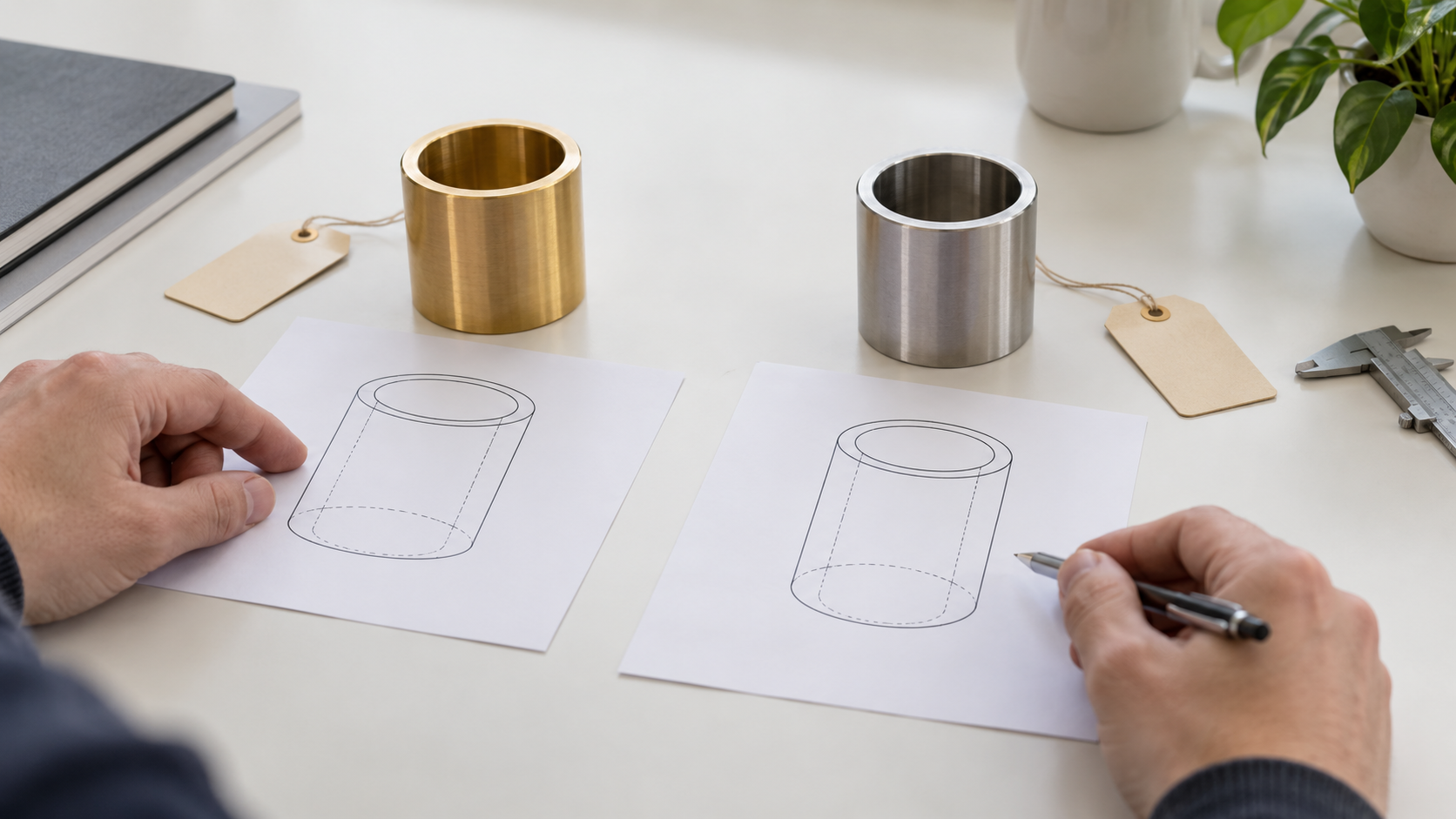
Conceptual illustration: brass-colored and silver-colored sleeves beside separate outline drawings.
Describe the disagreement without guessing its cause
Create one entry for each difference. State what the drawing indicates, what is observed on the sample, and why the feature matters to the product. Use an annotated photograph where it makes the observation easier to understand.
For example, a sleeve may appear longer than the drawing suggests, or a mounting opening may sit in a different position. Record how the observation was made and ask the responsible colleague whether a proper measurement is required. A photograph can reveal a question without providing a reliable dimensional answer.
Keep explanations separate from observations. “Possibly an older version” is a hypothesis; a labelled drawing revision is a reference. This distinction prevents an informal guess from becoming a manufacturing requirement as the enquiry is forwarded.
Find the person who owns the requirement
Ask the product or engineering owner which controlled specification should govern the next step. Purchasing can assemble the evidence, but it should not select the convenient version simply to obtain a faster quotation. If customer approval is needed, include that responsibility in the decision.
The supplier may identify manufacturing implications or ask useful questions. That support does not automatically give the supplier authority to decide the intended product function. Record who can approve a clarification and where the resulting instruction will be kept.
MPIF's standards guidance emphasizes agreement between purchaser and manufacturer on relevant material and process conditions. A similar practical discipline helps here: make the agreed requirement explicit before manufacture, without presenting your discrepancy sheet as a technical standard.
Separate a quotation assumption from an approved requirement
Sometimes a preliminary estimate is useful while a discrepancy remains open. Ask the supplier to list the assumption used and the limits of that estimate. State which unresolved point could affect price, tooling, timing, or the proposed route.
If two alternatives deserve comparison, request clearly named options. Do not send a mixed instruction that combines the drawing's outline with the sample's opening and leaves the remaining features undefined. Each option needs enough coherence for the supplier to explain what has been priced.
Keep provisional estimates out of production instructions. Before releasing a firm order, confirm the chosen specification and ask the supplier to acknowledge it. An unanswered note in a quotation should not quietly become acceptance of an unknown feature.
Reconcile the function as well as the outline
Ask what the disputed feature does in the assembled product. A difference may affect clearance, movement, connection, appearance, or service access. The product owner should decide which checks are needed to confirm the intended result.
Metal Injection Molding (MIM) shapes a metal-powder mixture in a mold and processes it into metal. MIMA introduces the route and its shape capabilities. Considering that route for stainless does not resolve an ambiguity in the original brass requirement.
If the replacement intentionally changes a feature, label it as a proposed change. Keep it distinct from correcting an outdated drawing. Your team needs to know whether it is restoring the documented requirement or evaluating a different design.
Close the record with one usable instruction
For each discrepancy, record the decision, the authorized reviewer, and the updated reference. Mark unresolved entries clearly. Keep the original evidence so a later colleague can understand why the instruction changed rather than seeing only the final file.
Ask the supplier to confirm receipt of the agreed package and identify any remaining inconsistency. Check the quotation and sample request against it. The post-quotation change guide explains what to revisit if reconciliation changes a version already priced.
Retain physical references with matching identifiers. If an old sample remains useful for appearance or installation comparison, state that limited purpose. It should not regain authority over the full specification merely because it is the easiest object to find.
Make the uncertainty easy to review
A useful enquiry includes the conflicting references, a short list of differences, the component's function, and the person responsible for the final requirement. Add expected quantities and the reason for considering stainless, while keeping unresolved features visible.
Share that package with LP MIM and request a response against an identified version or explicitly stated option. The first useful outcome is a common understanding of the part to assess, rather than a precise price for an uncertain requirement.
Comments
Loading comments...