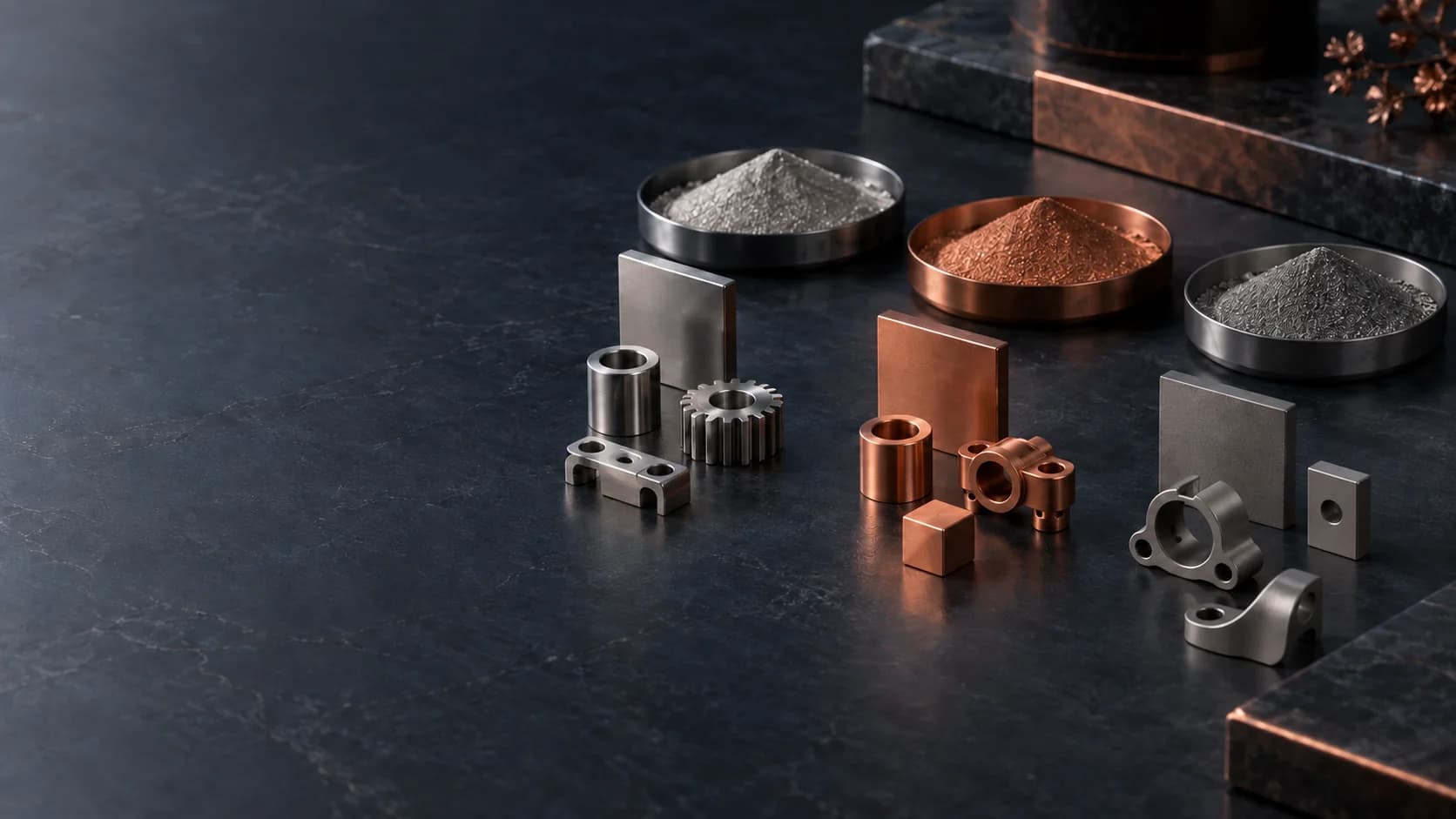
Find a material family for your component
Begin with the property that matters most in service. These material families are starting points for engineering review, not interchangeable specifications.
Stainless steel ↗
Corrosion & strength
Copper ↗
Electrical & thermal function
Titanium ↗
Weight & material condition
Illustrated material families · See the comparison below for low alloy and soft magnetic options.
Four questions before choosing a grade
01 / Working environment
Identify fluids, temperature, cleaning agents and corrosion exposure. Evaluate the finished surface as well as the alloy.
02 / Mechanical function
Describe loads, wear, repeated movement and the dimensions that control assembly or sealing.
03 / Functional properties
Specify conductivity, magnetic behavior or weight constraints with test methods and acceptance criteria.
04 / Manufacturing route
Review geometry, heat treatment, finishing and any secondary machining alongside material choice.
Compare material families
| Material | Selection focus | Engineering constraint |
|---|---|---|
| 304 stainless steel | General corrosion resistance and structural components | Water chemistry, finish and density still require validation. |
| 316L stainless steel | Corrosion-focused designs; low-carbon austenitic stainless | Chloride exposure and surface condition determine suitability; it is not corrosion-proof. |
| 17-4PH stainless steel | Strength-focused components with precipitation hardening | Specify heat-treatment condition and resulting dimensional/property requirements. |
| Copper | Electrical or thermal components | Conductivity, residual porosity, oxygen and measurement conditions are critical. |
| Titanium | Weight-sensitive and corrosion-focused designs | Grade, interstitial content, sintering atmosphere and qualification require specialist control. |
| Low alloy steel | Structural or wear-related applications with suitable heat treatment | Corrosion protection and heat-treatment distortion must be considered. |
| Soft magnetic alloys | Magnetic circuit components | Evaluate permeability, coercivity and losses under application-specific test conditions. |
Stainless steel MIM
304 and 316L are austenitic stainless options; 17-4PH provides a different, precipitation-hardening route. Compare the grade and its final condition together.
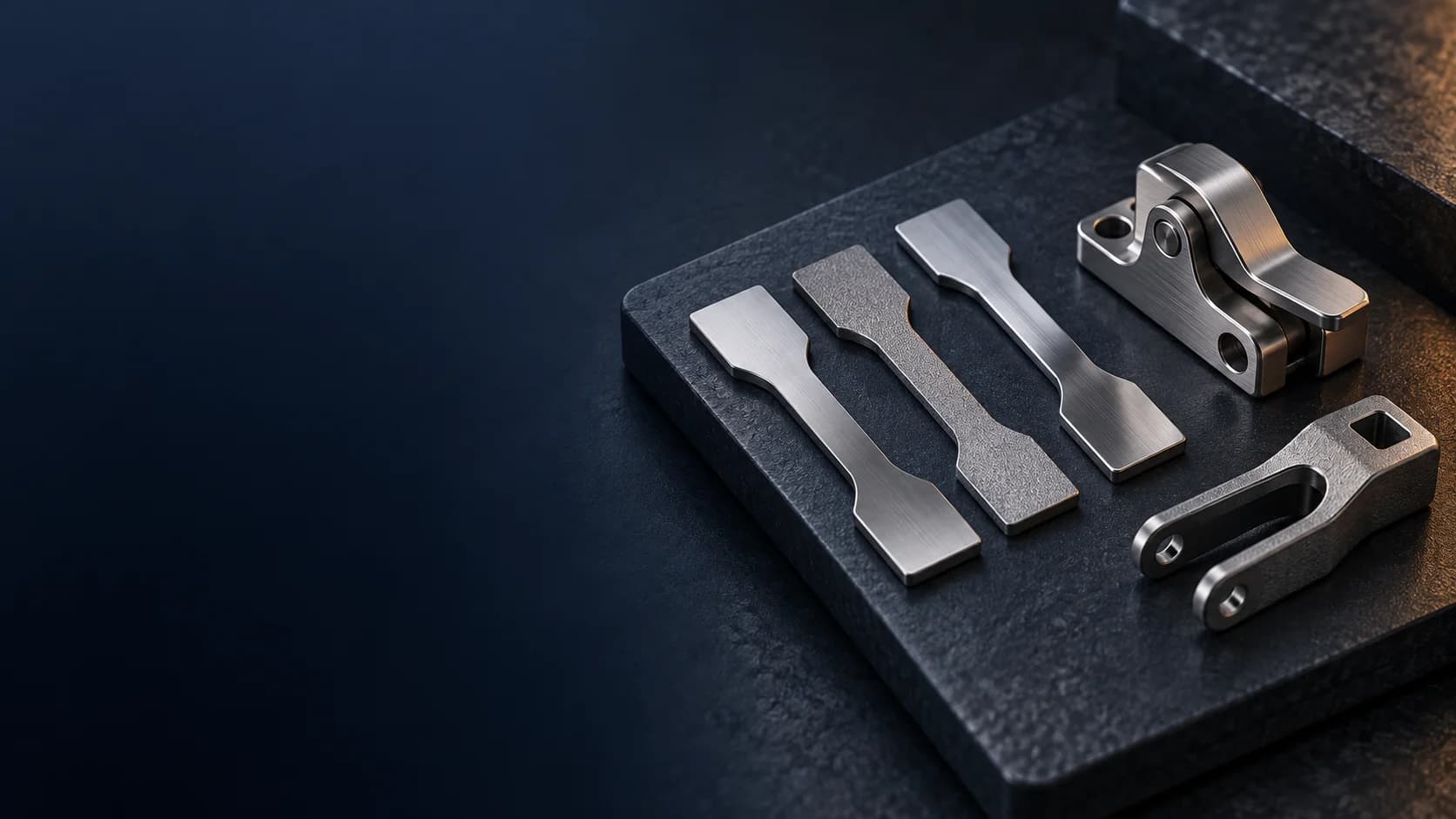
304, 316L and 17-4PH address different requirements. Review corrosion exposure, strength, heat treatment and the final surface condition rather than selecting on grade name alone.
Copper MIM: manufacture a copper component
Start with the electrical or thermal requirement. The finished component must meet that requirement after processing, not only in a reference material datasheet.
Copper can be processed using metal injection molding. Electrical and thermal performance depend on the material and processing route, including density and residual contamination. Specify conductivity with units, test conditions and a defined acceptance method.
Copper MIM is different from replacing a copper component with stainless steel. A material substitution must separately demonstrate that electrical, thermal and mechanical function is preserved. LPMIM must confirm the grade and manufacturing route for an individual enquiry.
Titanium MIM: grade and process control matter
Identify the exact grade, service environment and test requirements. Qualification belongs to the material and process combination used for the part.
Titanium MIM is used where its combination of material properties and complex geometry fits the application. Control of interstitial elements and the sintering environment matters. A material family name is not evidence of medical suitability or a qualified production process.
State the grade, material condition, test requirements and intended use in your enquiry. Do not assume general titanium reference values are guaranteed for a finished MIM component.
Separate material guidance from production qualification
- Agree grade, composition and required properties.
- Specify material condition and any heat treatment or finishing.
- Confirm manufacturing responsibility, sample availability and inspection records with the supplier.
- Validate the actual component against its working environment and acceptance criteria.
Technical references
- European Powder Metallurgy Association — MIM process fundamentals
- European Powder Metallurgy Association — Introduction to MIM: materials, design and properties
Published by LPMIM. External references explain general MIM principles; they do not certify a supplier or a specific component. Material properties, tolerances and acceptance criteria must be agreed for each project.