Brass parts become expensive long before anyone asks about Metal Injection Molding. Chip waste, copper-linked bar pricing, multi-setup CNC time and multi-piece assembly labor push unit cost up — especially on small complex fittings and valve internals. For a buyer, the useful first question is which brass components are worth a conversion review. Metal Injection Molding, or MIM, forms a metal-powder mixture in a mold before further processing turns it into a metal component.
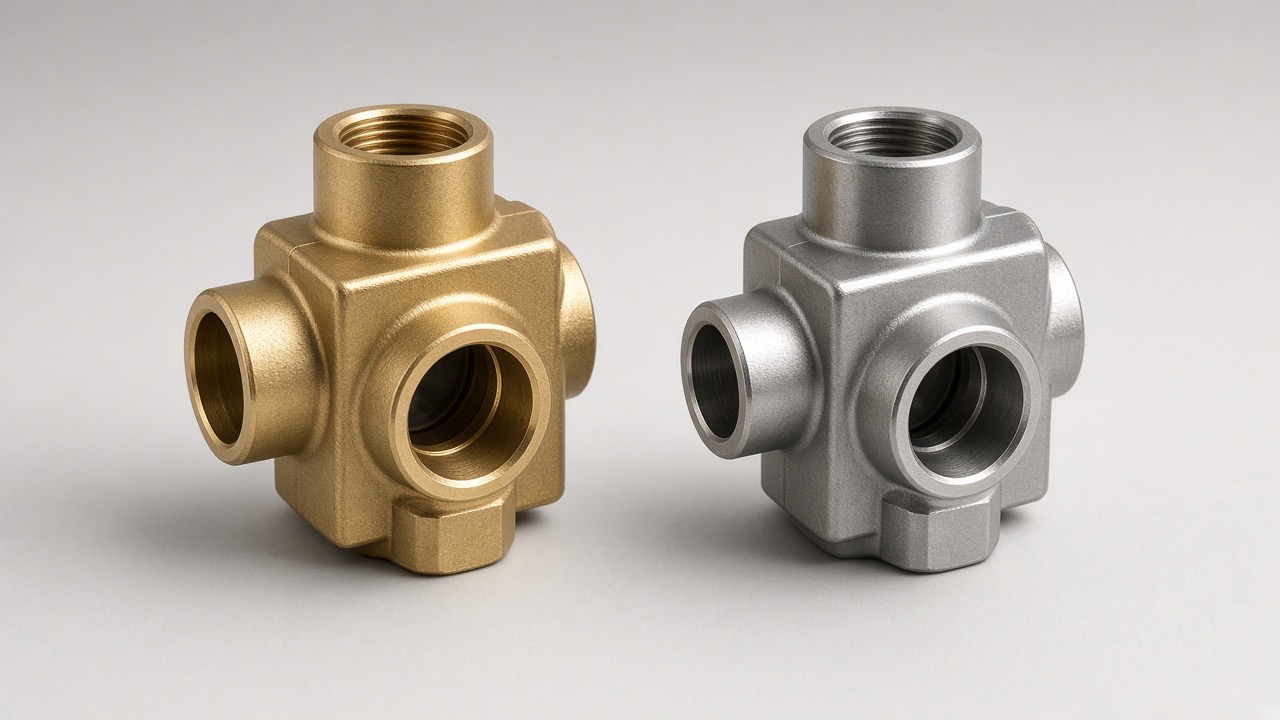 Conceptual comparison: machined brass versus stainless MIM geometry.
The manufacturing problem
Many plumbing, bathroom, HVAC and fluid-control BOMs still rely on free-cutting brass because it machines easily and has a mature installer ecosystem. That history does not protect the part when:
- Material cost tracks copper and alloy surcharges
- Internal ports force repeated drilling and milling
- Brazed joints create leak paths and inspection load
- Annual volume is high enough that scrap and cycle time dominate unit cost
Replace brass with MIM is a commercial service path. This article is the engineering screen that should happen first.
When the current brass process becomes expensive
Use these signals as a triage list — not as automatic conversion rules:
| Cost pressure signal | Why it matters | Engineering check |
|---|---|---|
| High chip ratio from bar or billet | You pay for metal that never ships | Can near-net geometry remove most stock removal? |
| Many CNC setups / fixtures | Labor and WIP multiply | Are features moldable or consolidatable? |
| Brazed or screwed multi-piece brass | Joints add leak risk and labor | Can one MIM body replace the stack? |
| Copper-indexed pricing pain | BOM volatility | Is conductivity not the primary function? |
| Stable SKU for multiple seasons | Tooling can amortize | Is the design close to freeze? |
Which components are suitable
Strong candidates for a brass MIM conversion review typically share several traits:
- Small to mid-size parts that fit MIM processing windows (often in the range of grams to low hundreds of grams — confirm per drawing)
- Complex features: ribs, pockets, retention geometry, internal galleries
- Repeated production with a foreseeable annual quantity
- Structural or corrosion-driven function where stainless can be qualified
- Tolerance plan that allows MIM near-net shape plus targeted post-sinter machining on seals or threads
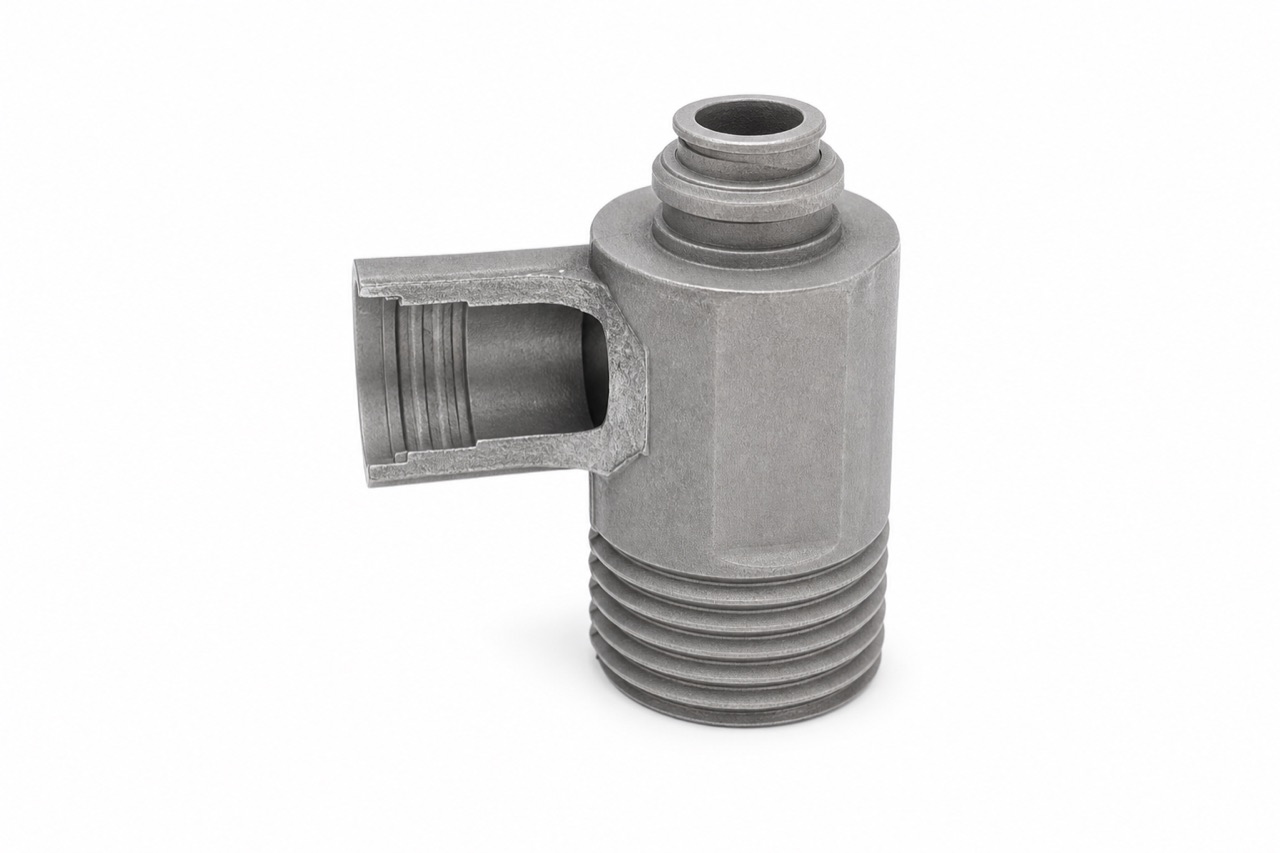 LPMIM product photography: threaded valve body geometry typical of conversion discussions.
Feature screening table
| Feature | Good MIM candidate | Poor MIM candidate |
|---|---|---|
| Size / mass | Compact, moldable envelope | Very large or heavy solid sections |
| Geometry | Complex internals, consolidation opportunity | Simple turned shapes easy on screw machines |
| Volume | Stable, repeatable annual demand | Prototype-only or frequent redesign |
| Material function | Strength / water corrosion / plating removal | Primary electrical or thermal conductivity |
| Tolerances | Critical faces can be machined after sinter | All-over CNC precision required |
| Assembly | Multi-piece brass → one body | Already a single simple forged blank |
Industry examples that often pass the first screen (subject to DFM):
- Valve inserts, cages, retainers and small housings — see plumbing components
- Faucet and shower internals where plating on brass adds cost
- Manifold sub-components that today are brazed brass stacks — see water manifold components
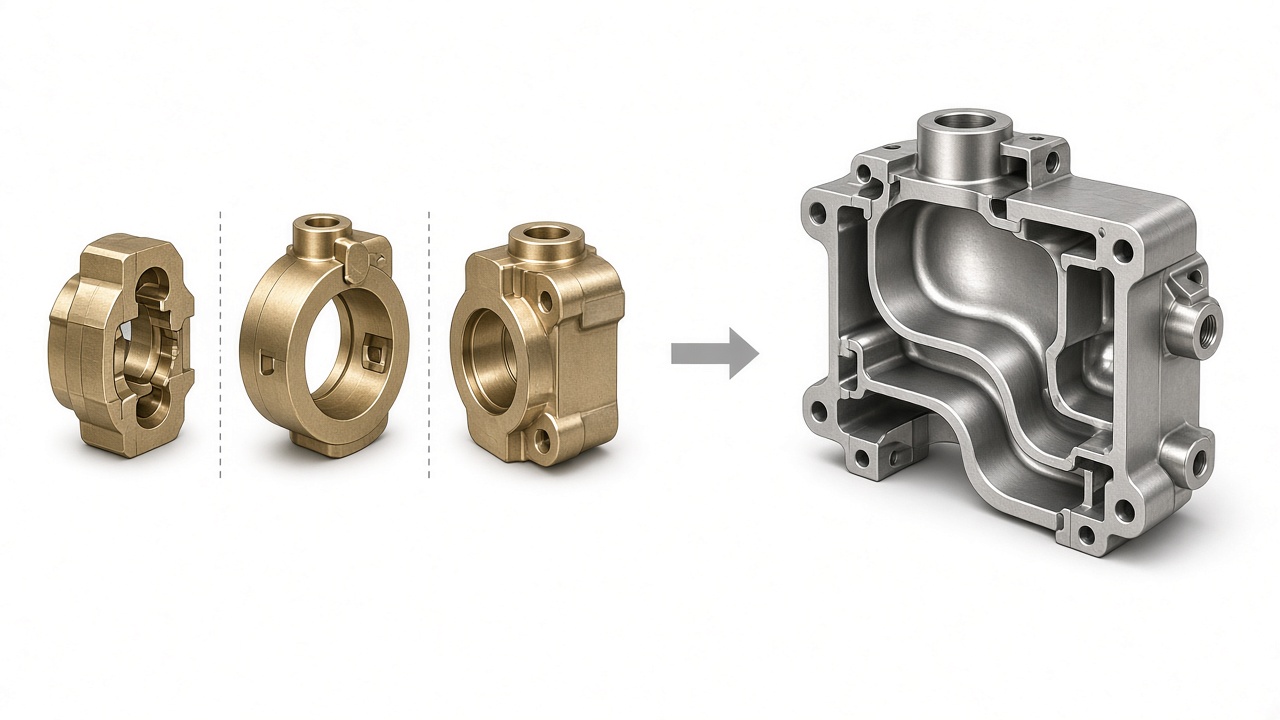 Engineering concept: multi-piece brass assembly versus a consolidated MIM body.
What your product team should check
Before you open a tooling quote, confirm:
- Material function — If the brass part is there for conductivity, treat copper/brass replacement with extreme caution (replace copper with MIM).
- Alloy choice — Water chemistry and chloride exposure drive 304 vs 316L (and sometimes 17-4PH for wear). See MIM materials. Base the choice on the product requirements.
- Wall uniformity — Isolated heavy sections warp in sintering. Conversion usually means redesign, not a 1:1 CAD swap (design for MIM).
- Shrinkage concepts — Green-to-sintered shrinkage is substantial and feedstock-dependent. The mold cavity is oversized to compensate. Residual dimensional variation after compensation is a separate topic. Confirm both in tooling trials.
- Threads and sealing faces — Budget post-sinter machining where function requires it.
- Certification path — NSF / WRAS / UL / FM acceptance is typically at assembly or listing level. Plan OEM qualification early.
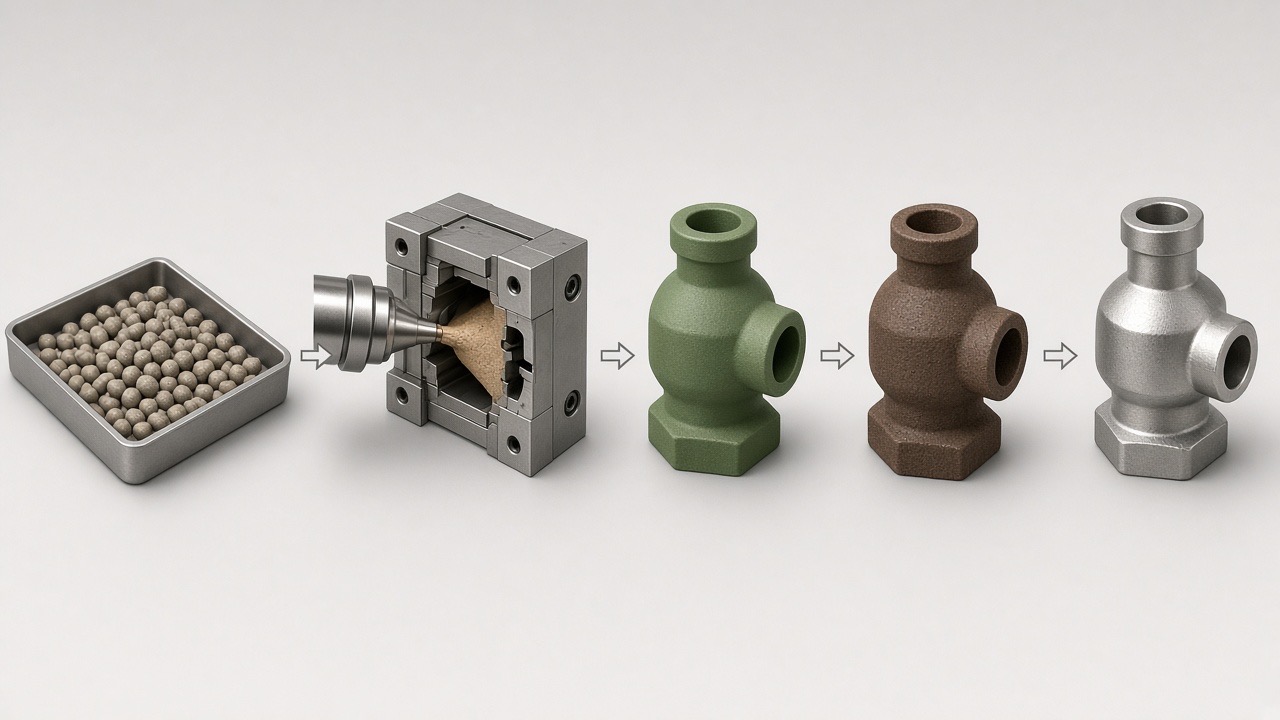 MIM process: feedstock preparation, molding, binder removal, and sintering.
Cost considerations
Do not compare “brass price per kg” to “stainless price per kg.” Compare the full stack:
- Material + scrap
- CNC cycle time and fixtures
- Brazing / plating / assembly
- Inspection and scrap rate
- MIM tooling amortization
- Secondary machining after sinter
- Qualification and inventory risk
There is no universal annual volume cutoff. Tooling payback depends on complexity and how many operations MIM removes. For a structured CNC comparison, see MIM vs CNC machining and our tooling payback article.
Example decision framework
- List brass SKUs with the highest unit cost × annual quantity.
- Mark each: conductivity-critical? / redesign-frozen? / complex internals? / multi-piece?
- Drop conductivity-critical and unstable designs.
- For remaining parts, request a MIM feasibility review with drawings.
- Classify outcome: suitable, suitable after redesign, or keep current process.
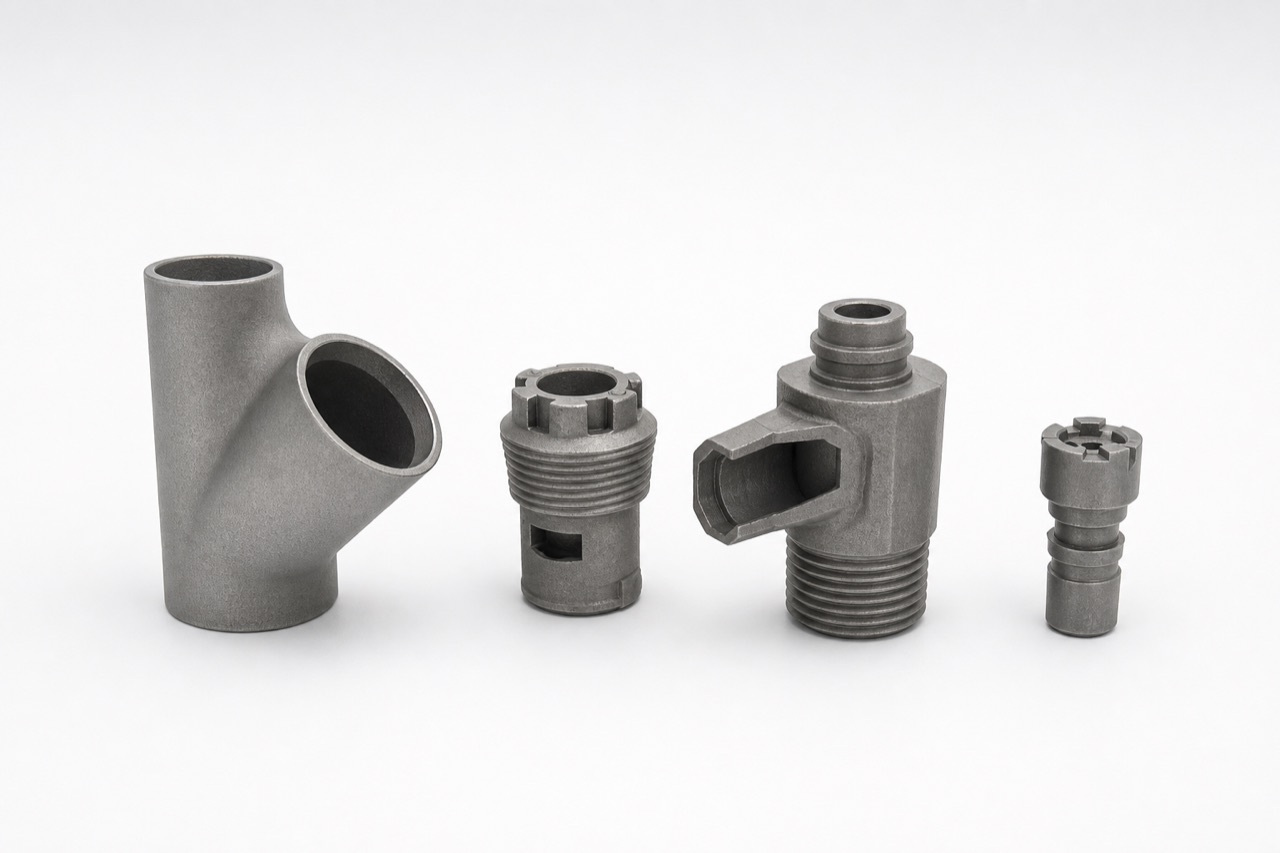 LPMIM product photography: representative MIM components for size and finish reference.
When to keep the current process
Leave the part on brass machining, forging or casting when:
- Volume is too low or design changes monthly
- The envelope is outside practical MIM size/mass windows
- Every surface needs machine-tool precision
- Function depends on brass-level conductivity
- Secondary machining would erase the near-net benefit
- Qualification timeline cannot absorb a redesign + FAI cycle
What information LPMIM needs to evaluate the component
Upload via Upload Your Part:
- STEP / STP / IGES and/or 2D drawing
- Current brass alloy
- Current manufacturing process
- Annual quantity and forecast stability
- Tolerance and sealing requirements
- Application (water, fire, HVAC, bathroom, etc.)
- The main cost problem you are trying to solve
LPMIM will review whether the component is suitable for MIM, potentially suitable after redesign, or better left as CNC / forging / casting.
Start with your component
Start with screening, not with a tooling PO. Upload your brass part for an engineering-first feasibility review, or read the commercial overview on replace brass with MIM.
Sources and scope
Prepared by LPMIM. This is a process-selection discussion, not a published customer test report or a performance guarantee. Validate material, dimensional and assembly requirements for the specific project.
Comments
Loading comments...