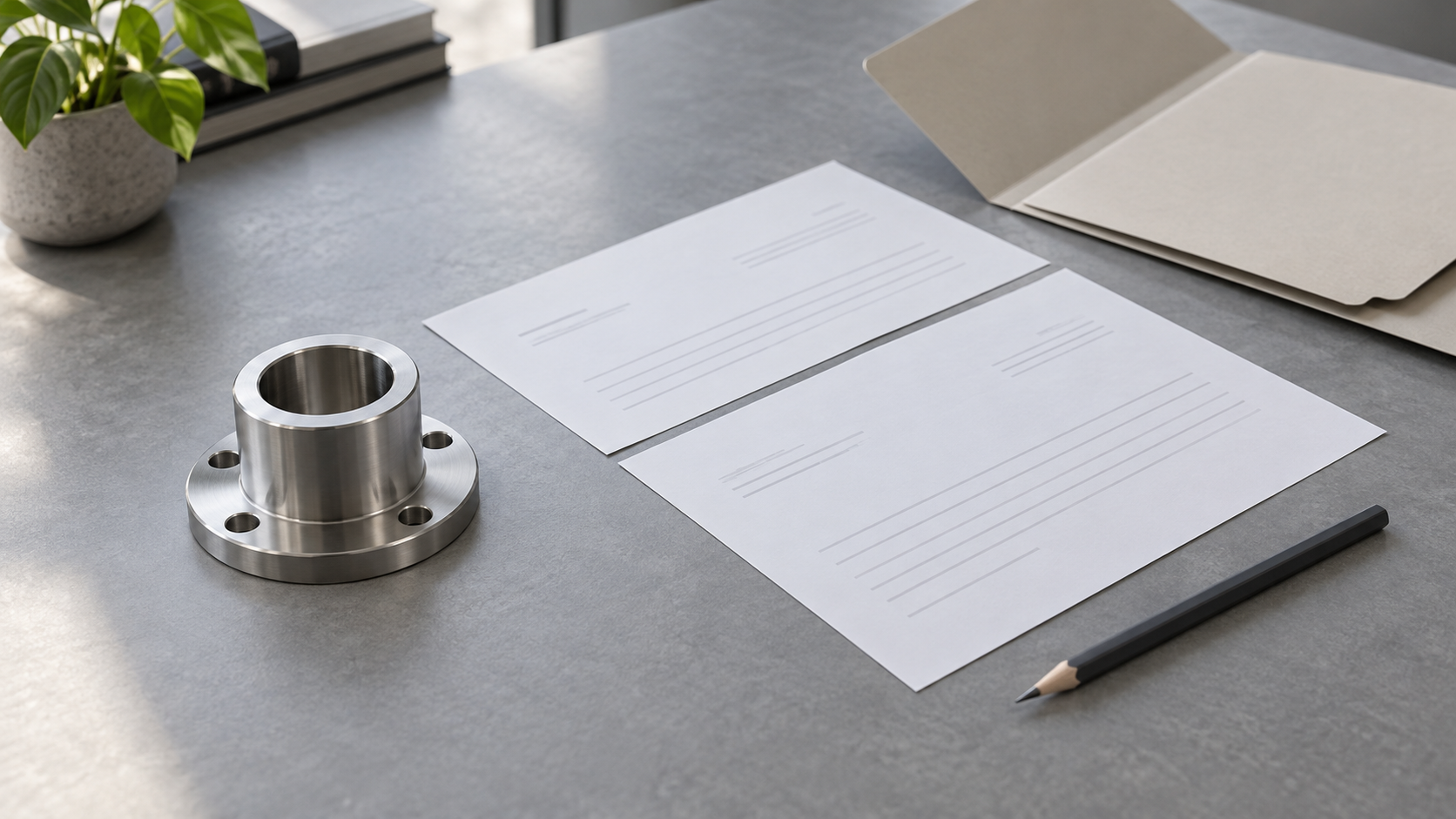
An order acknowledgement is worth checking before it becomes a reference for production planning. Compare it with the purchase instruction and accepted quotation, then resolve any differences in the component, quantity, finished scope, or timing. A familiar part description and a supplier reference number do not establish that every requirement has been understood in the same way.
This is especially useful during a brass-to-stainless transition. Old descriptions, revised drawings, and new finish requirements may all appear in the purchasing record. The acknowledgement should make it possible to see which arrangement the supplier has confirmed and what remains open before the business relies on the expected delivery.
Put the current documents together
Use the purchase order, accepted quotation, current specification, and any agreed clarifications as the comparison set. Check the revision of each file. If your own documents conflict, have the relevant owner resolve the discrepancy before asking the supplier to choose which one should govern production.
Find the component reference on the acknowledgement and establish how it connects to your part number. Suppliers may use an internal code, but that code should have a clear relationship to the item ordered. Do not assume a similar description identifies the correct material or product version.
Our repeat-order handover guide describes the accepted component package. The acknowledgement check is the order-specific step: confirming that this purchase uses that package, with any agreed differences explicitly recorded rather than carried through from an older order.

Conceptual illustration: brass-colored and silver-colored sleeves beside separate outline drawings.
Check the delivered component, not only its name
Compare material, finish, included operations, and required records. Metal Injection Molding (MIM) shapes metal powder mixed with a temporary binder in a mold, then removes the binder and heats the powder into a solid metal part. MIMA introduces the process. Naming the process does not describe the complete component your assembly team expects to receive.
CMG's design guidance includes secondary operations. If the accepted proposal includes additional finishing or machining, confirm that the order acknowledgement has not reverted to an earlier unfinished scope. Use explicit references where the full detail sits in an agreed specification.
For a hypothetical small housing, a familiar description might cover two different finishes or product revisions. Match the relevant identifiers and scope before assuming the acknowledgement is routine. The review should establish what will arrive, not simply whether the supplier has received an email.
Reconcile quantities and units
Compare the total ordered quantity, delivery quantities, and unit of measure. Check whether the acknowledgement describes individual parts, pairs, sets, or packs. Where a price or quantity is expressed per group of items, make that relationship clear enough for purchasing and receiving to apply consistently.
Look for any stated over-delivery or under-delivery arrangement and refer differences to the appropriate commercial owner. Do not silently accept a changed quantity because the total price seems close to the budget. Likewise, a staged delivery should show how the releases relate to the total commitment.
If the supplier confirms only part of the order, record the remaining status. Planning should be able to distinguish confirmed quantities from requested quantities still awaiting an answer. A single expected-arrival entry can hide that difference unless the acknowledgement review makes it visible.
Translate the timing into the event you need
Ask what each date means. Is it a production completion date, shipment date, expected arrival, or a date conditional on another approval? Confirm any stated starting event for lead time. An acknowledgement that depends on drawing acceptance is not the same as an unconditional arrival commitment.
Check that the destination and delivery scope match the arrangement approved by your business. Ask the responsible logistics or commercial colleagues to resolve unfamiliar conditions. Avoid converting an uncertain shipping estimate into a firm assembly date without understanding the steps between the supplier and your receiving location.
Our finished-supply responsibility guide helps establish who completes each activity. The acknowledgement should reflect that scope so required packing, records, or final checks are not discovered as exclusions after the component is already expected on the production line.
Resolve exceptions explicitly
Create a short list of differences and unanswered questions. Reference the relevant item or document rather than sending a general request to confirm everything. Ask the supplier for a corrected acknowledgement or a clear written clarification tied to the current order reference.
Separate a clerical correction from a proposed change to the agreed component or commercial arrangement. A revised material, finish, quantity, or delivery condition may need a different decision owner. Purchasing should route the exception appropriately rather than treating every supplier amendment as an administrative detail.
Keep the status visible while the question is open. Have the authorized people decide whether the affected activity can proceed and communicate that instruction through the established process. Do not let a planning system's expected date imply that an unresolved supply change has been accepted.
Preserve one usable order record
When differences are resolved, retain the final acknowledgement and its linked clarifications with the purchase instruction. Mark superseded versions as history. Update the planning and receiving information that depends on the confirmed arrangement, so the correction is not confined to one person's mailbox.
A colleague taking over the order should be able to identify the part, quantity, scope, timing, and remaining conditions quickly. That is a practical test of the record's usefulness. The purpose is to catch misunderstandings early enough to resolve them, while the parties still have a clear shared reference.
To prepare a stainless sourcing discussion, send LP MIM your component and required delivered condition. Explain the order references and confirmation information your team needs. A well-defined proposal makes the later acknowledgement easier to check and helps the purchasing decision carry through to the actual delivery.
Comments
Loading comments...