A stainless proposal can look attractive at the expected sales volume and much less convincing if a product launch is delayed. Before committing to tooling, ask whether the decision still makes sense under a slower start. The useful question is how much uncertainty your purchasing plan can absorb.
For a buyer replacing brass, this means keeping the opportunity and the commitment separate. You can investigate a promising component without treating a sales forecast as a confirmed order. Decide what evidence is needed before each additional expense, and identify the conditions that would make you pause.
Start with the uncertainty that matters
Ask sales and product colleagues what could change the forecast. A customer trial may still be open, a launch date may depend on another component, or an existing product may be losing demand. Name the specific uncertainty rather than adding a general caution to an otherwise precise spreadsheet.
Separate repeat consumption supported by purchasing records from demand that depends on an event. A forecast based on an unconfirmed customer programme deserves a different description from established replacement orders. Keep the source and date beside each assumption so the next review starts from evidence.
Metal Injection Molding (MIM) shapes a metal-powder mixture in a mold and processes it into metal. MPIF outlines the process. A route involving dedicated tooling makes the timing of your commitment worth discussing explicitly.
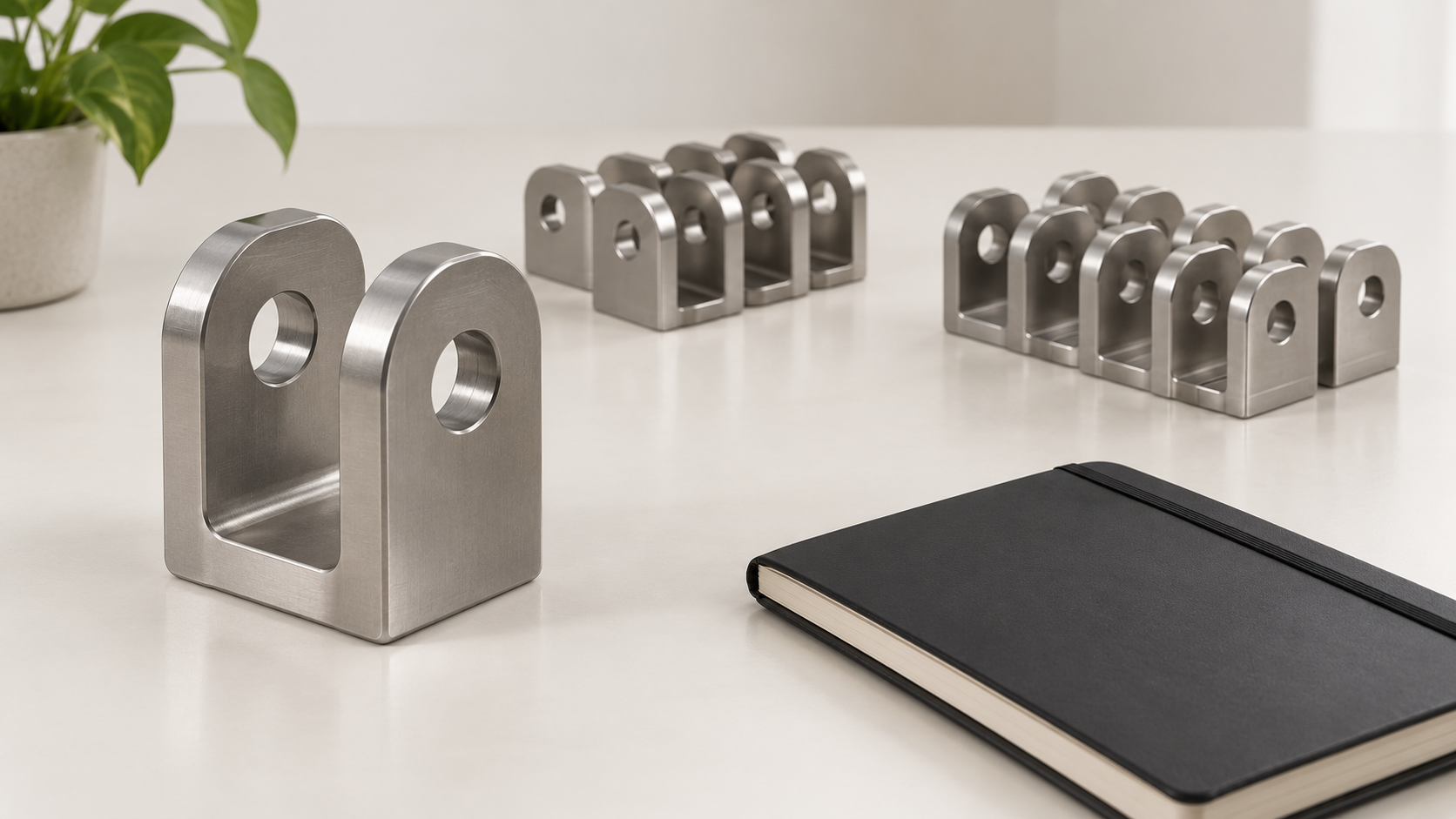
Conceptual illustration: metal clevis brackets arranged in separate groups beside a notebook.
Compare three plausible buying situations
Create a slower, expected, and stronger demand scenario using your own information. Each should describe when orders begin, what quantities are likely to be required, and how long the product may remain active. Avoid treating three arbitrary percentages as evidence of a realistic range.
Ask the supplier how the proposal changes in each situation. The answer might involve a different starting quantity, a different production route, or a revised commercial arrangement. Request the assumptions behind each answer, including which expenses occur before any production order.
Our annual demand and delivery guide explains quantities within an order arrangement. This review addresses the earlier decision: whether to enter that arrangement while the expected demand itself remains unsettled.
Identify the next irreversible expense
List what you are being asked to authorize now. Is it a feasibility review, sample preparation, a mold, or production material? Establish what that step delivers and which later decisions remain open. A staged discussion is useful only when the stages have clear scope.
Ask what can be stopped or revised after each stage and what cost has already been incurred. Have the appropriate purchasing colleagues agree the terms. Do not infer that a preliminary activity is refundable or that tooling can be changed without expense simply because production has not started.
For a hypothetical small bracket, early samples might resolve installation questions while a customer confirms a launch. That can be a sensible sequence if the sample limitations are understood. It does not establish that all projects should delay tooling until every commercial uncertainty disappears.
Keep the alternatives credible
Compare the proposed commitment with an actual alternative. Continuing the established brass supply, using a different route for early quantities, or postponing conversion may each deserve consideration. Ask for current information rather than assuming the old arrangement remains available indefinitely.
Include the work needed to qualify each alternative. A temporary stainless component made by another route may still need approval, and its price may not represent the eventual MIM part. Keep the bridge arrangement and intended repeat supply distinct in both cost and product records.
CMG's design guidance describes additional finishing operations. Whichever route is compared, request the same usable delivered condition. A low initial commitment is less helpful if it leaves essential finishing or acceptance work outside the proposal.
Decide what evidence would change your answer
Before the next meeting, write down the information that would justify moving forward. Examples might include confirmation of a customer programme, completion of a product trial, or a revised quotation for a realistic starting quantity. Choose evidence connected to the uncertainty you identified.
Also name a review point. A date alone is useful for coordination, but an event can be more meaningful: the end of a customer evaluation or availability of actual launch orders. State who collects the information and who can authorize the next expense.
Avoid silently changing assumptions to preserve the original recommendation. If demand falls, revisit the proposed commitment openly. If it rises, check supplier timing and capacity before treating the stronger scenario as a confirmed supply promise.
Record a conditional decision clearly
A useful decision can be conditional: proceed with a defined evaluation step, keep the current route for initial orders, and review tooling after an identified event. Record the scope, spending authority, remaining questions, and the evidence needed for the next decision.
The tooling payback framework helps structure the underlying cost comparison. The uncertainty review adds discipline around when that comparison is strong enough to support a commitment. Neither a favourable forecast nor an attractive sample removes the need to decide what you are authorizing.
To discuss a measured next step, send LP MIM your component and the demand assumptions. Include the current brass arrangement, what is confirmed, what could change, and the next decision you need to make. That supports a proposal suited to the information available today.
Comments
Loading comments...