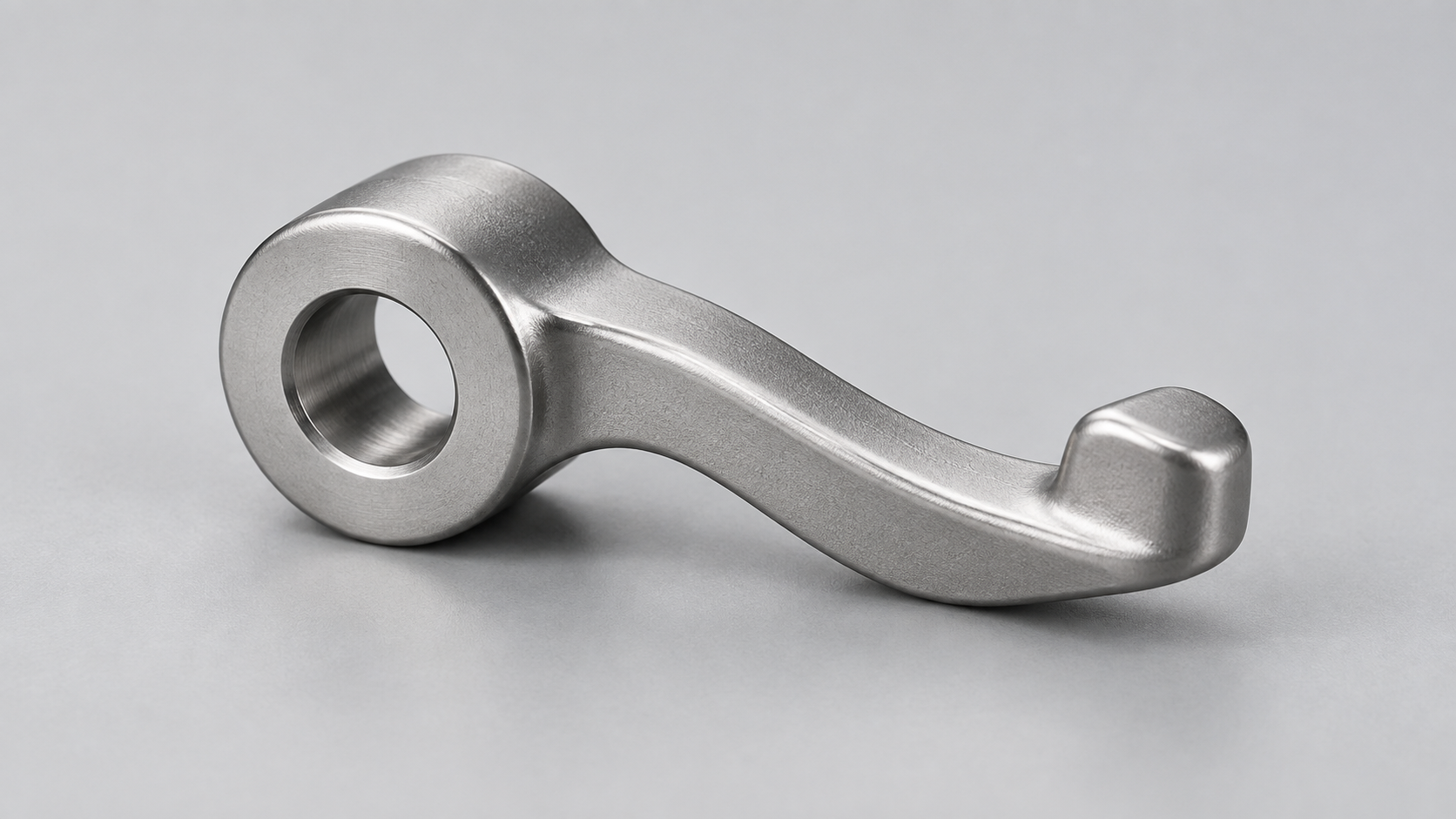
A brass component does not have to stay simple just because adding another curve, shoulder, or mounting feature would increase its machining cost. If your product would benefit from a more useful shape, metal injection molding may be worth discussing.
Metal Injection Molding (MIM) uses a mold to shape metal powder mixed with a temporary binder, followed by processing into a metal part. Its ability to produce complex shapes is a central reason manufacturers consider it. MIMA’s introduction describes this application.
For buyers looking at complex stainless steel parts, the practical benefit is design choice. You can ask about the shape the product needs, then compare ways of making it.
Describe what the feature should do
You do not need to start with a technical drawing full of new dimensions. Explain the problem in ordinary language: the handle is uncomfortable, the stop is fitted separately, or the part needs a feature that helps an operator position it correctly.
Consider a small lever as a hypothetical example. It might need a pivot opening, a curved arm for clearance, and a raised stop to limit travel. Those features serve distinct purposes. Reviewing them together gives the supplier a chance to propose a coherent shape, rather than price each addition as an isolated machining task.
Keep the discussion tied to the finished product. A curve that looks attractive but prevents assembly is not an improvement. A locating feature is only useful if it guides the part into the correct position in your actual product.
Ask which features can be formed together
Request a marked image of the proposed part. The supplier should identify features formed in the mold and any that will be finished afterward. That distinction makes the proposal easier to evaluate.
For example, the overall arm and raised stop might be formed together, while a particular opening still needs a finishing operation. A photograph of a smooth metal part cannot tell you which route produced each surface. Ask rather than infer.
CMG’s design guidance describes complex three-dimensional geometries and the use of secondary operations. These are general process possibilities; the supplier still needs to assess your particular design.
More freedom does not mean every shape is sensible
It is tempting to collect several attractive features in one sketch. A better starting point is the smallest set that improves the product. Show which features are essential and which are optional.
Ask the supplier to explain any proposed change in terms you can assess. Does it change how the part fits? Does it affect the user’s grip? Will the visible outline remain the same? Those answers are more useful at the buying stage than a long list of unfamiliar process terms.
Also confirm the approximate size. A production method that suits a small mechanism is not automatically the best choice for a large handle or housing. “Can be made” and “makes commercial sense” are separate conclusions.
Compare the complete proposed part
When a revised shape arrives, compare it with the existing brass component inside the assembly. Check the movement, access for installation, and contact with nearby parts. If a user touches it, include comfort and edge feel in the review.
Then compare quotations for equivalent finished parts. Both should include the required material, finish, quantity, and inspection. A lower price for an unfinished shape is not the same as a lower price for the ready-to-use component you need.
There is no need to redesign every feature at once. A focused proposal can retain what already works and improve one costly or inconvenient aspect of the current shape.
Separate essential features from useful extras
Before reviewing a new shape, divide your requirements into three short lists. The first contains features that must stay: the way the part connects, the space available, and anything a customer recognizes or handles. The second contains the improvement you want. The third contains details you are happy for the supplier to reconsider.
This gives the supplier room to suggest a practical shape without changing the product’s purpose. A mounting shoulder hidden inside a housing may offer more freedom than the visible end of a handle. A feature used during servicing may look unimportant in a photograph, yet be essential to the person repairing the product.
Ask for an image showing the proposed part beside the current part at a comparable scale. Have the supplier mark the changes and explain each one in a short sentence. Keep that image with the quotation so your team can see exactly which design has been priced.
At the sample stage, repeat the same review with the actual surrounding parts. Check whether the added feature saves handling time, improves positioning, or makes the product easier to use. Also check that it has not made another step more difficult. A shaped locating feature, for example, offers little benefit if it prevents an operator from reaching a fastening point.
The strongest result is a useful improvement that your purchasing, assembly, and product teams can all describe. Complexity has value when it serves those needs. It does not need to be added simply because a manufacturing route can produce it.
Bring the awkward part to the discussion
Choose a brass component whose shape currently limits the product or adds purchasing cost. Send a photo, an explanation of the feature you wish it had, and the quantity you expect to buy.
Our metal injection molding overview provides further context. For a specific proposal, share the component with LP MIM and ask which useful features could be formed together.
Comments
Loading comments...