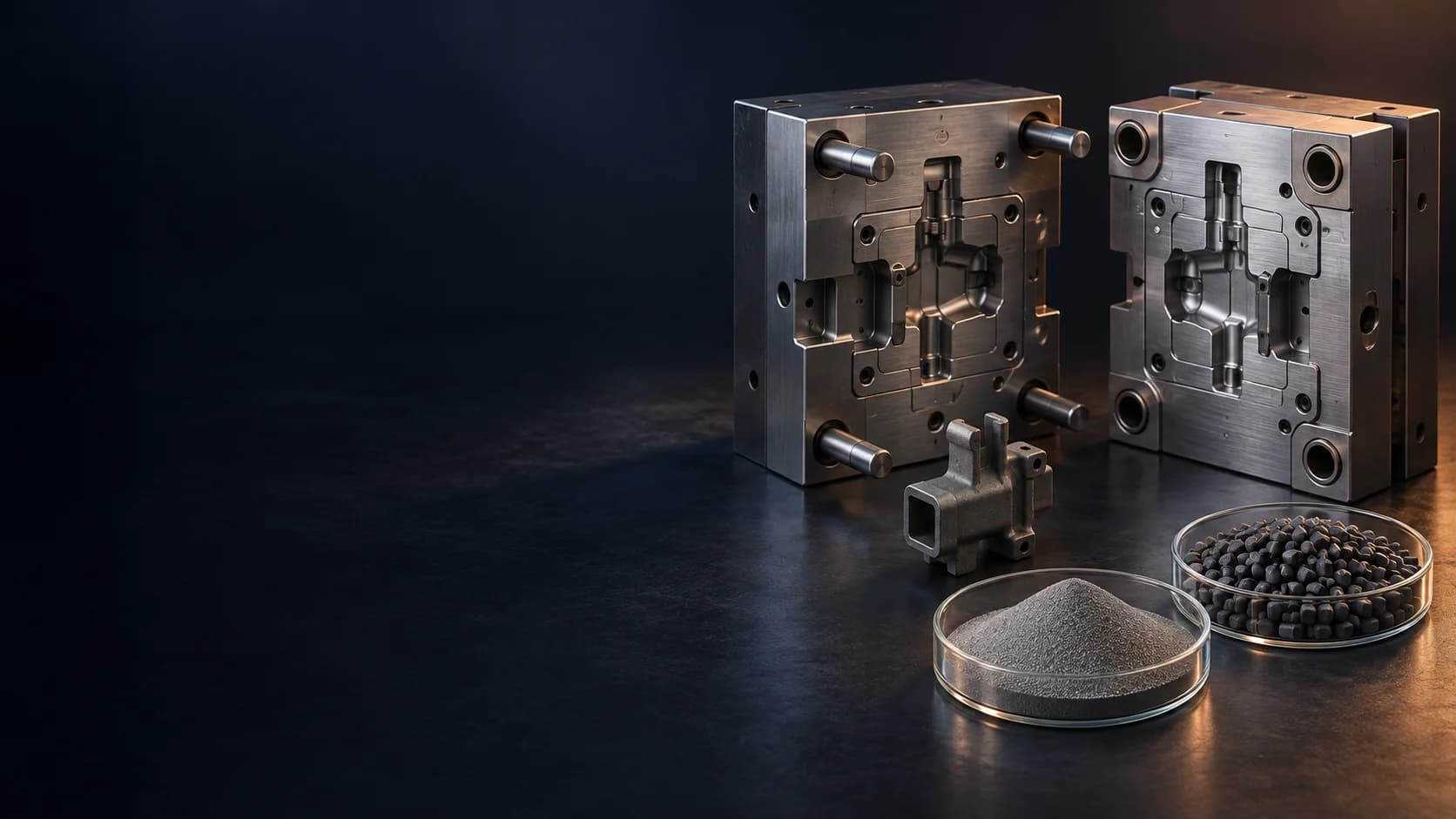
How the MIM process works
- 01
Metal powder
Fine metal particles are the starting material.
- 02
MIM feedstock
Powder is mixed with binder and made into pellets.
- 03
Injection moulding
Heated feedstock is injected into the mould.
- 04
Moulded part
A grey-black, binder-containing “green part” is ejected.
- 05
Debinding
Binder is removed, leaving a fragile porous part.
- 06
Sintering
Controlled heating bonds the particles and densifies the part.
- 07
Sintered MIM part
The same geometry is smaller after controlled shrinkage.
| Stage | What happens | Engineering consequence |
|---|---|---|
| Metal powder | Fine metal powder provides the metal phase of the component. | Alloy chemistry and particle characteristics influence processing. |
| MIM feedstock | Metal powder is mixed with a binder system and pelletized. | Powder, binder and solids loading influence the processing window. |
| Injection molding | Feedstock fills a mold to form a green part. | Gates, flow paths, draft and ejection must match the geometry. |
| Molded part | The binder-containing blank retains the molded geometry. | Green part is a process term, not a description of its color. |
| Debinding | Binder is removed using a route suitable for the feedstock. | The fragile part requires controlled handling and removal conditions. |
| Sintering | Controlled heating bonds the metal particles and densifies the part. | Shrinkage compensation and support determine the dimensional result. |
| Sintered MIM part | The smaller metal component is inspected; specified secondary operations follow. | Appearance depends on alloy, furnace atmosphere and finishing. |
When is MIM a useful manufacturing route?
MIM is often considered for small, complex metal components with repeat demand, where machining many features or assembling several pieces increases cost. Tooling investment and qualification must be justified by the product program.
- Good candidates often combine feature complexity, stable design and repeated demand.
- Low-volume prototypes, frequent design changes, large simple parts or extensive all-over machining may favor another route.
- Internal geometry must be moldable: MIM does not make every enclosed channel or undercut practical.
What materials can be used in MIM?
MIM is a process, not a material. Stainless steels, low alloy steels and selected copper, titanium and magnetic materials are used in the industry. The application defines the required properties; the supplier must qualify the exact grade and processing route.
Design, tolerances and surface requirements
Wall uniformity, draft, gate position and sintering support influence dimensional consistency. Critical interfaces may need secondary machining. Agree tolerances with their nominal dimensions, datums, material condition and inspection method rather than applying one percentage across a whole drawing.
Cost and minimum order quantity
There is no universal quantity at which MIM becomes cheaper than CNC. Compare fixed tooling and qualification costs with recurring costs per accepted part: feedstock, molding, debinding, sintering, finishing, inspection, yield and logistics. A commercial minimum batch and the economic break-even quantity answer different questions.
From a sample to a production agreement
- Define material and finished-part requirements before tooling release.
- Review first articles against the drawing, including secondary operations.
- Agree inspection methods, acceptance limits, traceability and documentation.
- Separate component verification from the customer’s finished-product qualification.
Frequently asked questions
Is MIM the same as plastic injection molding?
Both shape material in a mold, but MIM uses metal powder with a binder. Debinding and sintering produce the metal component and introduce additional design and process requirements.
What is MIM used for?
Industry applications include small housings, mechanisms, valve internals and structural components. The appropriate process depends on the actual drawing and production requirements, not the industry label alone.
Does MIM eliminate machining?
Not necessarily. Critical threads, bores, sealing faces or tight geometric requirements can need machining after sintering. These operations belong in the original cost and quality plan.
Technical references
- European Powder Metallurgy Association — MIM process fundamentals
- European Powder Metallurgy Association — Introduction to MIM: materials, design and properties
Published by LPMIM. External references explain general MIM principles; they do not certify a supplier or a specific component. Material properties, tolerances and acceptance criteria must be agreed for each project.